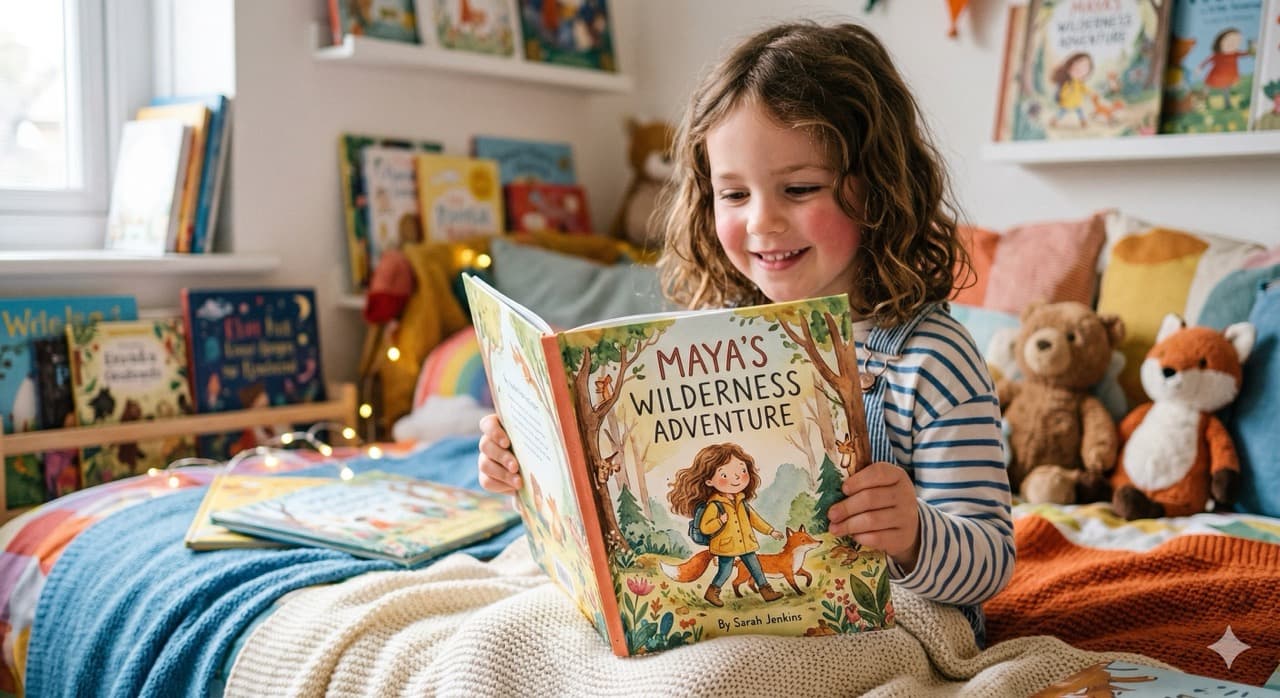
There's a moment that parents describe again and again. Their child opens a personalised book, turns to the first page, and sees a little illustrated character staring back at them — with their hair, their face, their spirit. And the child says: “That's me.”
Then they ask to read it again. And again. And again.
Is that just novelty? Or is something deeper happening? We went looking for the research — and what we found was genuinely compelling.
Not all personalised books are the same
Before we get into the science, it's worth making a distinction that matters a lot: there's a spectrum of what “personalised” actually means in children's books.
At one end, you have name-only personalisation — the mail-merge approach. A template story where “[Child's Name] went to the forest today.” The illustrations show a generic character. It's charming, and kids do enjoy hearing their name. But the child isn't really in the story.
At the other end, you have photo-accurate illustrated personalisation — where a character modelled on the child's actual features appears throughout the illustrations. Their hair colour. Their face shape. Their smile. That's MakeMyStory.
This distinction matters because the research doesn't treat them the same. And once you understand why, the difference makes complete sense.
What the research actually says
The science behind personalised reading draws on several overlapping bodies of research.
The most foundational is the self-reference effect — a phenomenon documented by Rogers, Kuiper, and Kirker back in 1977 that has been replicated consistently for nearly five decades. The core finding: information connected to the self is processed more deeply and remembered for longer than neutral information. When something is about us, our brains prioritise it.
In children, this effect is particularly powerful. A study from the 1970s still holds up today because it taps into something fundamental about how human memory works — not a quirk of one generation or one culture, but a feature of how we're all wired.
More recently, researcher Daphna Oyserman's work on identity-based motivation (2015) extended this into the domain of learning and engagement. Her research found that children invest more effort in tasks they perceive as connected to their identity — their sense of who they are. A story where a child sees themselves as the protagonist isn't just fun. It's motivationally meaningful.
Researchers studying personalised reading materials have found consistently higher engagement, better comprehension, and stronger enthusiasm for re-reading when children encounter content that feels personally relevant. The “read it again” request isn't just habit — it's a signal of genuine engagement.
We think of this research as evidence-informed rather than a precise controlled trial of MakeMyStory specifically. The science points in a clear direction. What we do is designed to lean into that direction as fully as possible.
Seeing your face versus reading your name
Here's where the distinction between name-only and photo-based personalisation becomes especially interesting.
Visual self-recognition develops remarkably early — most children recognise themselves in a mirror by around 18 months, and in photographs by age two or three. By the time a child is four or five, their visual sense of self is deeply embedded. They know what they look like. They notice when an illustration looks like them.
A character who shares your child's name is an abstract connection. A character who shares your child's face is something different entirely — it activates a deeper sense of identification. Developmental psychologists describe this as visual self-representation, and it triggers stronger identity recognition than text cues alone.
Put simply: when your child sees an illustrated character that looks like them, the brain doesn't just note the match — it maps the story onto the self. The character's adventure becomes their adventure. The character's courage becomes their courage.
“When a child sees their own face in a story, the book stops being about a character and starts being about them.”
What MakeMyStory does differently
Most personalised books — even photo-based ones — use a photo as a sticker or badge placed onto an existing illustration. The rest of the art is generic.
MakeMyStory works differently. When you upload a photo, our pipeline analyses your child's distinctive features and builds an illustrated character who appears consistently across all 12 pages — in different poses, different expressions, different scenes. It's not a collage. It's a genuinely illustrated character modelled on your child.
You can read more about the research behind our approach on our Science page, where we go into more depth on the developmental psychology that informed how we built the product. The short version: we designed MakeMyStory specifically to activate the self-reference effect as strongly as possible.
We also don't just customise the character — we generate the entire story around your child's age, interests, and chosen theme. The narrative is theirs, not a template with their name inserted. See more about how the story generation works.
What parents tell us
We could cite studies all day. But the thing that keeps us going is what parents write to us after their child receives a book.
One mum told us her daughter — who had been reluctant to sit still for books — asked for her MakeMyStory book every night for two weeks. “She just kept saying, 'Read the one with me in it.'”
A dad wrote to say his son had started pointing at the illustrated character and explaining the story to his little sister — retelling it from memory, with surprisingly accurate detail.
A grandparent told us she watches via video call while her granddaughter reads it. “She stops on every page and tells me what she's doing in the picture. It's become the highlight of our calls.”
Repeat reading. Retelling. Emotional connection. These are the markers that reading researchers look for when they want to measure genuine engagement — and they're exactly what parents describe.
For the sceptics
We want to be honest with you: AI illustration isn't magic. Some pages look better than others. The character won't look like a photograph — it'll look like an illustration, which is both the limitation and, we think, the charm.
That's why we built in touch-ups — if a page doesn't look quite right, you can request a revision. We think the process of seeing the first draft, tweaking it, and arriving at something you love is actually part of what makes the book feel like yours.
And the engagement effect? The “read it again” requests, the retelling, the pointing and identifying? Those happen even when an illustration isn't perfect. Because the child isn't judging art quality — they're responding to the deeply human experience of being seen, recognised, and celebrated.
That part works. The research says so. And every parent who's watched their child read their book confirms it.